“Telling My Truth”: Tanya Birl-Torres on Sojourner, Richmond, and the Work Behind the Show
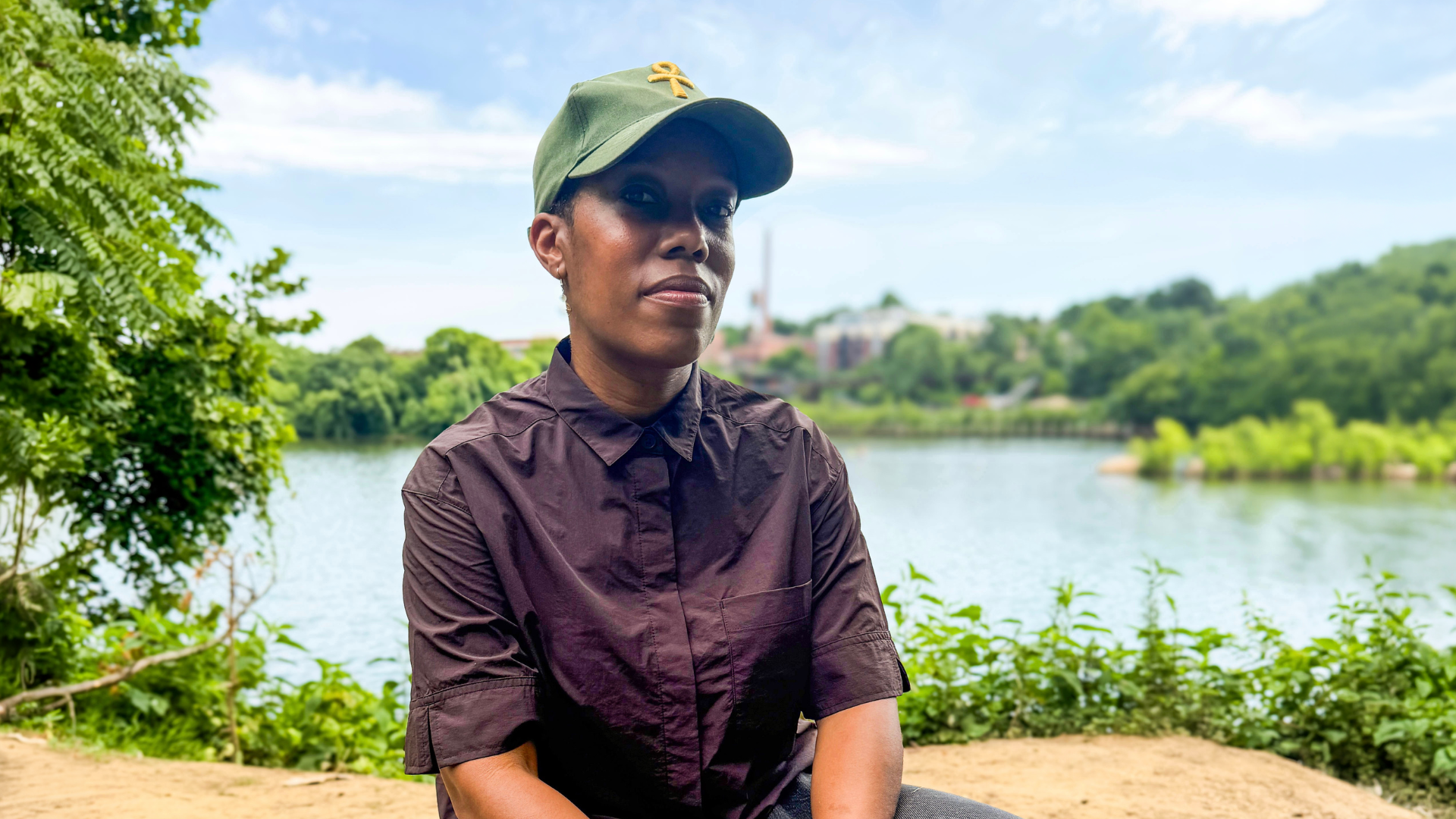
Photo credit: Patrick Mamou
On Saturday, June 20 — the day after Juneteenth — SONGS OF TRUTH: The Awakening, a concert celebration of songs from Truth: The Musical, the developmental staging of the life of Sojourner Truth, took the stage at the Hippodrome Theatre in Richmond, Virginia's Jackson Ward. The next morning, its director, Tanya Birl-Torres, walked on the southern bank of the James River with her father, along the Trail of Enslaved Africans, hours before her flight back to New York.
Birl-Torres is a director, choreographer, and self-described embodied systems–change facilitator whose career has moved between Broadway stages and the kind of community-centered, social-practice theater where, as she puts it, "the relationships are the center of the art making." What follows is drawn from two conversations we had with her, lightly edited for length and clarity.
For a project like Reconstructing Richmond — which sits with this city's layered history of slavery, emancipation, and an unfinished reconciliation — Birl-Torres talked ongoingly about the ethics of that exact work: how you tell painful history without re-inflicting it, who gets to be at the center of the telling, and what it really costs to do it well.
"I felt incredibly calm"
She came to Truth sideways. Already choreographing the Broadway-bound Midnight in the Garden of Good and Evil, she was connected to the project's writer through mutual producers who, she says, "know what I love and the stories I like to tell." The piece had begun as a 2024 concert in Richmond — the writer (and producer), Keni Fine, pulling together local artists around a canon of original songs — before she was brought in to shape it toward a staged production: a song cycle with projection, lighting, and movement.
The night itself surprised her.
"I've performed my whole life and career, and I've never been nervous to perform on stage. The most nervous I am is when I'm in the director's seat… because you can't control what's going to happen and what other people are going to do. But weirdly enough, last night I felt incredibly calm. I've been working really hard at releasing what I can't control, and I've never done that more than I did last night."
That sense of release, it would turn out, was something she'd begun on purpose — and would return to in our second conversation.
Centering the narrative
Ask Birl-Torres what makes interracial collaboration transformative rather than merely diverse, and she doesn't reach for representation. She reaches for position.
"Any show that has been about Blackness that I've done — except for one — has been written and directed and produced by white people. So to me, what makes it transformational instead of just diverse is the centering of the Black narrative. And then what happens to the white people who are involved is that they decenter themselves without leaving completely. That's true allyship — being at the perimeter. Because Black folks, especially in America, have always been on the inside of the outside of everything… which gives us a lot of perspective."
The distinction she keeps drawing is between reading about this and doing it.
"That's what the pandemic did — everyone was reading the books and doing the things. But to do it in actual practice… is a lot harder, a lot more uncomfortable, more painful than folks might think. We're doing a show, but the show is the icing. It's the actual act of producing and creating this — that's the revolutionary work… We get psyched out when we think, oh, I'm producing a show about Sojourner Truth, so that makes me an ally. That's not it. It's in the actual behavior, and how you position yourself around the story."
We ended the first morning with her name and a declaration.
"My name is Tanya Birl-Torres, and I am telling my truth."
___________________
Two days later, we spoke again. She was basking in the lingering celebration of the Knicks' championship and back in work mode.
In our second conversation, she clarified the meaning of "centering" — and named the conversation underneath it.
"A lot of well-meaning people would say, well, I am centering, because it's about you. But centering means from the mouth of, in the experience of. … Everyone in any situation coming together to tell a story — especially a painful story about the past — needs to be able to sit in the room and think: what is my position of power in this? Who has the money? Who's writing the story? From whose perspective is it being told? Who's being asked to embody it? … You democratize the power in the room so that there's less room for harm."
This is not abstract for her. Birl-Torres also works as a cultural consultant, brought in to ask those questions of a creative team before a cast is ever hired — a practice she traces to the theater world's reckoning after George Floyd, and one she'd "love to be happening everywhere."
Sojourner, then and now
Birl-Torres has worked with Sojourner Truth, she says, "as an ancestor and a mentor for about ten years." Her instinct as a director was to resist the temptation of the exceptional.
"A lot of the time, we get stuck telling these miraculous stories — it's like the talented tenth, look at this exceptional Black human. My thing coming into this was: Sojourner is every Black woman I know. And that's not to diminish her — it's to say we all stand on her shoulders."
Asked what Sojourner might recognize about America today, she answered without flinching.
"I think many of these ancestors would be like, wow, a lot hasn't changed."
She suspects Sojourner — who "really understood how to get white people to trust her," who "spoke so eloquently even though she didn't know how to read or write" — had to code-switch in ways Birl-Torres feels she now has "the privilege to be liberated from."
And in a show called Truth, the question of what truth-telling demands in 2026 sits close to the surface. She frames the American struggle not as ignorance but as avoidance.
"I think it's facing truths that we already know deep down. But there's this level of guilt and shame on all parts. … I feel like there's guilt on one side and shame on the other, and when those two come together, it's almost like a truth killer. We've got to feel the energy of guilt and shame — really feel it, not just intellectualize it — to transmute it into courage and love so that we can actually get to the truth."
Courageous truth-telling, for her, comes down to refusing to manage other people's feelings: "not sparing other people's feelings to save yourself… because to me, it's actually a form of manipulation to keep people from the truth."
The weight in the room
If there is a center of gravity to our conversations, it is Birl-Torres's insistence that historical trauma is not safely in the past — it walks into the rehearsal room in the bodies of the people asked to perform it.
"There was a song in the show called Hail Mau Mau… As we all know, these Black women were wet nurses — nursing these white babies, these slave owners' babies, while trying to raise their own kids. There was a moment where Mama had a white baby and was nursing it, and I saw the actor have this little wince — and in that moment I went, okay, that needs to become a Black baby. I know that's what happened, but we don't need to do that right now. It's hard enough that her Black babies were sold."
"And then one of the actors said, I had to actually leave the room when we were singing that song, because my mother raised a white family and I had to raise myself… That's when my job as a director is to realize this isn't just putting on a show. People are being triggered. The trauma of what we think is the past is very present right now. What responsibility do I have? Do we tell it just because this is what happened — or do we look at the bodies in the space, and bring integrity to it that honors them?"
Holding that tension — between honoring history and protecting the living — is, she says, the actual job. She is careful here, too, about a vocabulary she thinks has gotten slippery.
"Conflict is necessary in creativity. It's like a diamond — it doesn't become what it needs to be without pressure. What I had to learn was how to hold that pressure in my body… The words "harm” and “safety" have also been weaponized. You call harm, and all of a sudden, everything's got to stop. So we've got to be really honest: is something harmful, or is it truthful? Is something safe, or is it comfortable? We can't afford to just be comfortable — and we can't afford to be harmed either."
The throughline, in her telling, is staying in your body when the instinct is to flee — a tendency she sees in herself and observes, often, in well-meaning white collaborators who "want to flee out of guilt, shame." Quoting the writer Zora Neale Hurston, with whom she has worked extensively, she calls the aim being "cosmic and human at the same time": spiritual beings who nonetheless refuse to skip past the human mess.
What only theater can do
For all the weight, Birl-Torres is unguardedly in love with the form — a dancer who "tripped and fell into theater," who, "like many Black people, The Lion King got." She makes a case for live performance as the most human of the arts.
"We are collectively in a space together experiencing something that you'll only get that one time — that note, that little mistake that happened, that's only going to happen that night. Not even film can do that. With theater, you get your own original. I saw it this night, and no one else saw it like that. It's humanity at its absolute finest."
It's also, she argues, uniquely capable of the thing a divided country keeps failing at: getting different people to build something together under pressure.
"I think coming together around a shared goal — not even a shared mission or value, just a shared goal. … We had a month and a half; I was only here for seven days total. We had a lot of pressure, and we could either crumble or empower each other and rally. It doesn't matter what you look like, it doesn't matter your race — we all knew we had to put up this show. That's the power of it."
Does understanding across racial difference require agreement? She laughed, and offered the most quotable theory of the day.
"If white people played Spades, we would not have… I feel like Spades could fix a lot of this. I learned that discourse, tension, even argument does not mean disconnection, or that anything's wrong. It absolutely requires the ability to debate, to not agree, to not even land on agreement — but to speak what you feel honestly to each other. Let's just teach the world Spades."
Richmond, and a moving target
Birl-Torres had never been to Richmond before this project. She left convinced that the work belongs here.
"It's literally everything. Nothing would have ever brought me to Richmond other than this… Black people in Richmond are magic, period. Literal magic. … I know Sojourner had a hand in this. She was like, girl, get out of New York, and go down to Richmond. I really think it needs to be developed here."
She sees a larger shift in the south — away from the "big ivory towers of institutions" up north, toward where she thinks the next movement is being made. And in a city where Juneteenth is both a celebration and a reminder of delayed freedom, she resists the idea of freedom as a destination at all.
"What is our definition of freedom? Freedom is a moving target. We're never going to actually reach the promised land — there is no promised land. That's the whole point of humanity: you're always reaching for this thing. To be liberated is one thing, but to be free is a movement. You don't arrive. And I think that's beautiful, actually, because that keeps us making the art, keeps us evolving. … It's a cyclical process — a spiral that's moving in all directions."
After the curtain
When we spoke again two days later, Birl-Torres described what the first conversation had left in her — not sadness, she was careful to say, but something she's learned to name more precisely.
"Right after that first interview on the slave trail, I felt what I used to call sadness, but I don't call it sadness anymore. It was a mixture of really profound grief and gratitude together. The grief is in the necessity of letting go… every time a project ends, there's some kind of crash. But this time, I was aware that I needed to let go of some stuff before I even came. … It's the least nervous and the most calm my body has ever felt, because I started the grieving earlier than I ever had before."
Part of the gratitude, she said, was simply being met.
"The serendipity of me meeting you that night — you seeing me, and being interested in the narrative from my perspective. That just doesn't happen often; I usually have to fight for it. And that means I could stay soft. As a Black woman, I don't feel like I get to move about the world feeling soft very often."
The clearest insight to surface afterward was a decision about power — and capital.
"The tagline is: I need to produce my own work. To truly control a narrative in our patriarchal capitalist society… the capital is what usually dictates the content, and I've never had proximity to a lot of capital. … I'm calling it the Ryan Coogler — now Jalen Brunson — effect. Brunson took $100 million less to build a team around himself because he wasn't the one everyone said would be the next big thing. He had to believe in himself and what he could build. So the biggest realization for me is: what does it mean to truly invest in yourself? And who do you need around you to do that?"
Her definition of allyship, by the end, had narrowed to something almost behavioral — a practice, not a posture.
"Listening is more than hearing. Hearing something is one thing; listening, to me, is taking something in, pausing, and shifting a behavior because of it — so the other party knows you've heard, listened, and adapted."
And when conflict came — as it did, she says, a few times — her instinct as the director was to "call that person in" rather than flee or carry the grievance elsewhere.
"If everyone could listen, pause, and redirect — let the pause be long enough that you can come back and ask the questions you have — that type of maturity… I go back to the James Baldwin quote on love. That is love embodied. That's the state of grace. I can model it, and I think I did. And then it requires everyone to take the same posture."
"A beautiful first step"
Asked what it would mean for this experience to become a catalyst for growth, Birl-Torres returned to the idea that the show was never the point.
"Growth would look like coming back to the drawing board. We had a QR code that got feedback from the audience, and I just got the data back — so growth looks like honestly sitting around that data and receiving what was said. It's about widening the scope of who's involved, and really having a truthful conversation about power and everyone's position in relationship to it."
"I've said this to Keni before: the creation of the work is the work. The product is the icing, something to enjoy. What I invited everyone into when I spoke at the top of the performance was — you're getting a glimpse into the beginning of a developmental process. From the moment a writer hands a script to a director, to the Broadway stage, is traditionally seven years. It takes a lot of courage for a writer to hand over their work. What we did the other night was a beautiful first step."
She hopes audiences leave Truth talking about motherhood, about "the true humanity of Black people," about a long-held truth they might finally be brave enough to say "in love." In her director's notes, she wrote that she had redirected the entire play toward "an audience of one — a young Black girl." It is, she says, the principle beneath all of it: "When a Black body heals, everyone heals."
Tanya Birl-Torres directed SONGS OF TRUTH: The Awakening, a concert celebration of songs from Truth: The Musical, developed in Richmond and staged at the Hippodrome Theatre on June 20, 2026. This conversation was conducted by Patrick Mamou of Reconstructing Richmond on the banks of the James River and in follow-up two days later.